Sunday, 22 May 2016

16 to 19 May

Still walking and gardening.

Monday 16th May to Thursday 19th May

On Monday morning  I went out into the garden to photograph pignuts before the sun got too bright and saw that the first buttercups were opening on the wild flower bank - another sign that it won’t be too long before summer arrives.


The pignuts are putting on a good display this year and, together with the yellow poppies and red centranthus, help to hide the unsightly dying leaves of the daffodils.


We walked down to the Sulby after lunch.  The only ducks on the river were a couple of males.  Not a baby in sight. When we reached Poyll Dooey we heard a small bird making an alarm call in a holly tree near the car park.  Something had obviously disturbed it.  Before it flew away we got a brief glimpse of its grey breast and distinctive black cap . . . it was a male blackcap.  We usually only see blackcaps in our garden when the raspberries are ripe.  This was the first time I had seen one in spring.  I read that they arrive in Britain in April and May and leave in September or October.

On the way home there was a cacophony of rooks at Milntown - in the tall trees near the road.  I was surprised because there are no nests there.  The rookery is the other side of the MIlntown grounds near the golf course.  The birds were too high up for us to get a clear view of them but  I saw one of the birds begging for food and realised that it could be a fledgling.  When we got home I did a bit of research and found out that young rooks fledge when they are about 33 days old and leave the nest.  They then roost in nearby trees to remain close to the parents and continue their relationship with the parents for several weeks until they are fully independent.  So all the noise was probably due to hungry youngsters shouting at their long-suffering parents for food.

A grey heron flew up from the river as we crossed the bridge on our way home.  It perched on a branch of one of the old Scots pines overhanging the water.  So I did get one bird photo.


On Tuesday morning I had a long session of murdering dandelions.  Technically it isn’t murder.  It is better described as attempted murder or GBH because I never get the whole root out - so the plants don’t actually die.  But it does inhibit them for a while and stops them spreading seed.

Some weeds are welcome in the garden, like the white stitchwort near the elder tree in the daffodil bed by the wooden fence.  The only things which have been planted in this bed are daffodil, snowdrop and crocus bulbs.  A pheasant ate most of the crocus bulbs but a few survived and are spreading again.  The wild flowers like the stitchwort, bluebells and primroses just moved in without being invited.


Other weeds are not so welcome.  I try to keep the garden free of most of the weeds which produce wind dispersed seeds - like dandelions, willowherbs, and ragwort.  I also have an irrational dislike of some others like the tiny hairy bittercress.  And I spend hours weeding out ferns - apart from the ones by the ditch, and on the banks and next to the stone boundary walls.  I cut these back in autumn to reduce the spread of spores but it doesn’t help much because the garden is so damp for most of the year that ferns grow almost too well.

The bottom of the garden has recently been invaded by a tiny weed that has defeated me.  It is a creeping oxalis and must have moved in from a neighbouring garden.  It has tiny yellow flowers and I think it is oxalis exilis and originates in New Zealand.  I suppose it is fair enough for New Zealand to send us some annoying weeds because they did inherit a lot of weeds from Britain.  When we visited our daughter in Balclutha many years ago, nearly all the weeds in the neighbourhood gardens looked familiar.  

The oxalis may have moved here from the cottage garden across the road.  The small garden was “landscaped” a few years ago and some weed seeds may have been introduced in the soil around new shrubs from a garden centre.  I suspect  that garden was also the source of the fox and cubs or orange hawkweed (Pilosella aurantiaca).  This came up under the hedge first and then moved into the bottom of the garden.  The orange hawkweed has quite pretty flowers so I didn’t try to eradicate it.  But I may regret this because it is already spreading.

We went for a fairly long walk after lunch.  We decided to walk up Skyhill and follow the path along the top of the plantation.  We crossed the mountain bike bridge between the two sections of the plantation and ended up walking further than we intended - all the way to the northern end of the hill.  We wanted to find out the route taken by the bike race.  The walk was interesting but not very photogenic because it winds through conifers most of the way.  There were just brief glimpses of the northern plain on the west side of the hill.


The route followed paths that we had walked along in the past apart from a short section approaching the stream below the bridge - where it wound between the trees above the old path near a wall.  We turned for home before the Cyclefest route turned downhill - apparently to join up with the forestry road down to the Millennium Way.

In the evening we had an unexpected visitor - a very inquisitive one.  While I was preparing supper I noticed the plants moving on the wild flower bank and watched closely because I suspected a cat.  Then I saw a spiky back and rushed to call Tim and fetch my camera.  At first I couldn't see the hedgehog and thought I had imagined it - but then I saw it up by the ditch near the summerhouse.  I followed it with my camera but didn't get any great shots.  The light was fading and it spent most of the time snuffling around in the plants with it head hidden by the leaves.


After a while it turned around by the summer house and walked back towards me.  I kept absolutely still and it had a good sniff at my old slippers and then stuck its nose under the hem of my jeans to check my ankle!  Luckily it decided that I wasn't edible.


Wednesday.  Another Poyll Dooey walk after lunch. We have had very little rain recently and the Auldyn River looked more like a stream than a river.


After passing the turning circle near the new houses we saw that the first hawthorn flowers were opening.


We listened for the blackcap near the car park but couldn’t hear it and decided to take advantage of the dry conditions underfoot to walk all the way through Poyll Dooey to the salt marsh area to see whether the thrift and scurvy grass were flowering.  There were some flowers but they weren’t putting on much of a show so I just took one photo of some thrift . . .


. . . and then we walked back through the Legion Wood.  I hoped they might list the trees on their sign but there were only photographs of the birds that we might hope to see there.  


They did mention that sixty trees of six different species had been planted to represent the six years of the war and the sixty years since it ended.  I shall try to identify and list the six species of trees in this part of the park during our next visit.

On the way home we heard the raucous cries of rooks again.  There was a small group in the sycamores across the river but they flew away when we approached.

We arrived home to find that our annual confetti time which started a few days ago was now in full swing.  Drifts of pink cherry petals were blowing down the road and the shallow water in the ditch by the old stone wall had turned pink.


On Thursday we left earlier than usual for our walk because rain, heavy at times, was forecast for the early afternoon.  We drove to Maughold Village for a Brooghs walk.  This was our second recent “outside the glen walk”.  I have an unexpected ally in my low-key campaign for more varied walks . . . the blue Golf.  We were going to use it to drive to Tim’s appointment at the hospital in Douglas last week but it refused to start.  It didn’t matter because we have the old red Golf as backup.  The problem occurred because we both prefer driving the old car and the blue Golf had been sitting in the garage for so long that its battery had gone flat.  After having its battery recharged we are trying to use it more.

I didn’t think it would be worth taking photos because it was cloudy and grey skies mean grey sea but I must be addicted because I ended up with 41 new photos.  After the last post I resolved to stop taking bluebell photos.  But my resolution didn’t last long.  When we turned down the Brooghs footpath from the parking area I couldn’t resist North Barrule and Maughold churchyard (with bluebells in the foreground).


And Maughold Head (with bluebells in the foreground).


The path winds along the a slope with fields of lambs to our left and a slope down to the top of the cliffs on our right.  At times we walked through a corridor lined with flowering gorse.


Next we passed the old Scots Pines - still standing on the windy slope (with bluebells in the foreground).


The Brooghs walk is usually good for birdwatching and Thursday was no exception.  We saw ravens, great black-backed gulls, cormorants, herring gulls and choughs and nesting seabirds on Stack Mooar and on the cliffs.  I wondered whether the choughs would be nesting in the old ruins at the top of the cliffs near the slate quarry where we have seen them in previous years.  Sure enough a pair appeared.  One flew straight down into the ruin and the other waited on top of the wall.


As we approached the road we passed this view of Port e Vullen with Ramsey in the background (and the inevitable bluebells in the foreground).


The road back to Maughold village passes fields of sheep and I was interested in this one which looked a bit like a cross between a loaghtan and a Jacob.  So I did some sheep research on the computer and now I think it may be a rare breed from the Netherlands - a zwartbles.


We weren’t sure whether to walk the extra loop down to Port Mooar and back along the coast but the wind was getting stronger as we approached the car and we decided that it could bring the rain earlier than expected.  So we left that part of the walk for another day and headed home.  It was a wise decision because the rain started as we drove through Parliament Square in Ramsey.

Thursday, 19 May 2016

12th to 15th May

More walks and some gardening.

Thursday 12th May to Sunday 15th May

After morning tea on Thursday we drove down to Ballaglass Glen to see the bluebells.  We took the scenic route through Maughold Village and Ballajora.  It was another warm, sunny day but the air was rather hazy, not ideal for distant views.

While I was waiting for Tim to put on his boots, I managed to photograph two butterflies near the car park.  They were both whites and both males.  The light was too glary to get really good photos of white subjects in the sun but the photos are good enough for identification.

A green veined white.

An orange tip.

We saw quite a few other whites on the walk but they were all too far away and too active to identify.  The only other butterfly that we saw close-up was a speckled wood.

We decided to walk through the glen to the bottom gate near the Mill House, take the rough  track through the Barony down to Cornaa, and then return by the same route with a detour around the best bluebell patches in the glen on the way back to the car.   

It was yet another case of best laid schemes ganging agley.  When we reached the short section of footpath through the Mill House garden, and the smaller branch of the river, we discovered that  the bridge was no longer there.  It must have been a victim of the winter floods. The river is shallow but we didn’t want to risk wet boots at the beginning of the walk so we walked back upstream and did our bluebell tour before setting off down the road.  Dorothy hadn’t exaggerated.  The flowers were absolutely lovely.


As we walked down the road past the Mill House, I stopped to take some photos of the missing bridge and we realised that something even more important than the bridge was missing from the scene. The huge rhododendron tree, said to be the largest in the British Isles, was no longer standing in the front garden.   I cannot believe that it would have been deliberately removed so I assume it was also a victim of the winter gales and raging flood waters.


11th April 2012 - my last photo of the famous old tree.


On our way down to Cornaa we came across some workmen using a small earth-moving machine to repair the surface of the track.  They stopped to let us pass.  We decided to change our plans and walk back via the road over the Cashtal yn Ard hill so that we wouldn’t hold up their work a second time.

There was no escaping bluebells during the walk, there were patches all the way along our route.  These were growing amongst the ferns behind an old moss covered stone wall not far from the ruins of the  belllite factory.


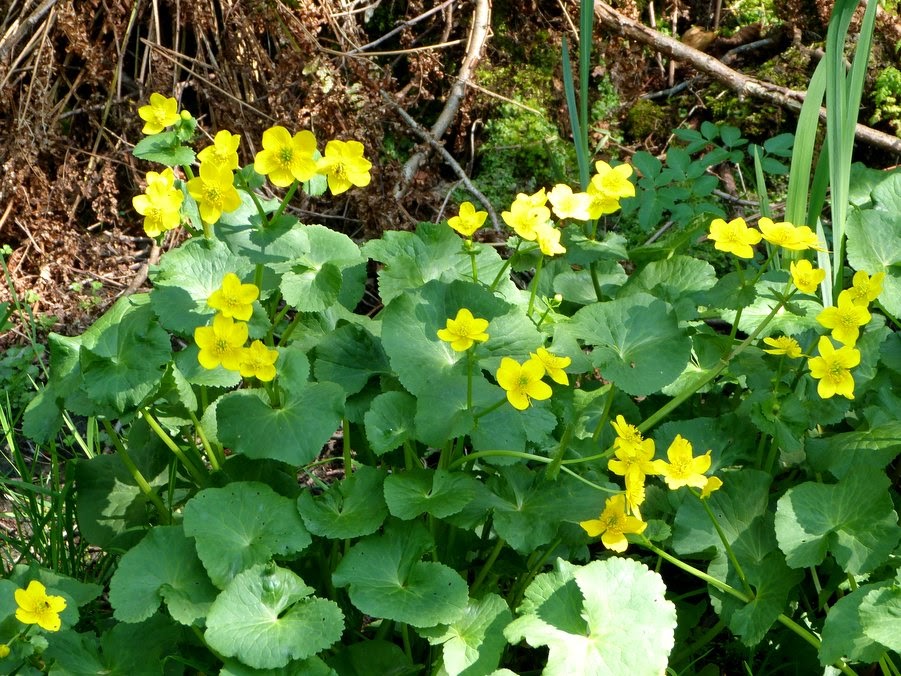
Down at Cornaa we saw the last of the marsh marigolds.


And as we started up the hill on the last leg of our triangular walk, we found a big patch of pink purslane growing on a steep bank above the road.  This is a magnified image of the tiny flowers.


As we approached the top of the hill these stunted oaks were a warning of how hard life is up in the windswept hills for even the toughest of trees.


The gorse seems to cope with the wind though, and patches of bluebells and white stitchwort thrive on the sheltered side of the bank.


We thought we deserved a rest on Friday after the longer than usual walk the day before and I took advantage of the break in exercising to mow the grass.  The only interesting event was the sighting of the first butterfly in the garden.  Yet another unidentified white.

Saturday was the day of the big mountain bike race in our plantation.  It started at Milntown at 10 a.m.  I decided to take some photos and found a good place at the top of a bank just inside the gate into the plantation.  While I was waiting I took some photos of the bluebells on the slope above the track.  They are improving every year and should soon rival their celebrity cousins in Ballaglass.


There were more entries to the race than I expected and it took about two and a half minutes for all the bikers to pass me.


When I walked back down the road I was shocked to see how quickly parts of our beech hedge had shot out.  Some of the new shoots were nearly a foot long.  I usually give the hedge a spring haircut during TT race week when the roads are closed  but that is not until June so I will have to start earlier this year. When I got home I  took this photo of my favourite shrub in the garden - the azalea mollis.


In the afternoon we went for a walk in Skyhill Plantation (as far as the top of the Ballagarrow paddocks) - safe in the knowledge that all danger of speeding bikes had passed.  I wanted to see the bluebells in the field near the farm boundary but they were disappointing this year.  The grass had grown too long, possibly because of the warm, wet winter.


On Sunday we had to sandwich a short walk in between the motor racing and the tennis on TV so we chose the top of the glen road walk.  Before we left I spent about an hour making a start on the beech hedge and then tackled the long shoots on the clematis that were threatening to block the front steps.

There wasn’t much to see on the walk but I rather liked the sun shining through the new red leaves of this acer in Fern Glen.   It made a change from all the greenery.


Later, while I was pulling out a few weeds near the gate I noticed a little wild garlic flower under the Lawson’s cypress.


I had been thinking about planting a few bulbs near our stream but was dithering because it can be quite invasive.  Then I remembered seeing some leaves that looked suspiciously like garlic under the forsythia by the crab apple last year - and went to check.  Sure enough there were a few flowers there too.  If I remember I may dig them out and plant them in a better place near the stream.  I didn’t know that birds ate the garlic seed but some of them must.  There is no other way it could have travelled into the garden.

While I was searching for garlic, I noticed that there was blossom on the crab apple . . .


. . . and the  Solomon’s seal had suddenly shot up and had buds.  It often gets attacked by slugs and sawfly larvae so I took a quick photo while it was still looking good.


Before I went inside I saw that the first oriental poppy had opened down by the turning circle.  We waited for so long for spring and weren't expecting to see the first sign of summer so soon.


Monday, 16 May 2016

6 May to 11 May

Five warm spring walks

Friday 6 May to Wednesday 11 May 2016

After a cold start to spring there was a sudden change in the temperature on Friday 6th May.  Instead of the usual maximums of 10 to 12 degrees C - the temperature “soared” to a predicted max of 17 degrees on Friday, then gradually increased until it reached 21 degrees on Monday - a record high for the 9th of May on the Island.  This was followed by three more hot days before it started to return to more normal temperatures for this time of year.  The unusually hot sunny spell of weather caused a surge in spring growth - blossom opened almost overnight, leaf buds unfurled on the deciduous trees and the glen resonated with the sound of lawnmowers trying to tame the rampant grass.  It was wonderful weather for walking.

Friday  It should have been just a regular Whitebridge and Poyll Dooey walk . . . but it wasn’t.  It was special because we heard the distinctive call of a cuckoo as we passed Milntown.  It was the first time I had definitely heard a cuckoo on the Island.  Years ago, I thought I heard one further up the glen but I wasn’t positive.  But this time Tim heard it too - and we checked the call on the Internet.  It was definitely a cuckoo . . .  unless someone was playing a recording of a cuckoo very loudly in the Milntown grounds.

There wasn’t much to photograph at Poyll Dooey apart from new leaves and the last of the dazzling white froth of blackthorn flowers near the entrance to the park.


Saturday  A rainy day.  A friend sent me a photograph taken through her bedroom window so I sent this in return . . . our wet patio and the first blossom starting to open on the flowering cherries.


Sunday was brighter and we walked down to Poyll Dooey again.  We listened for the cuckoo but it had departed, probably in search of a mate further afield.  The only sound of spring was the roar of motorbikes speeding along  Lezayre Road.

I continued my examination of the new leaves on the trees in the park  - trying to identify them.  A row of trees that we had not noticed previously had interesting coppery leaves which looked poplar-shaped.  When we got home I found some very similar photos on the internet and decided that they must be black poplars (populus nigra) - a native tree that grows well near water.  According to the Woodland Trust black poplar is the most endangered native timber tree in Britain


When we got home I photographed the first pink clematis flower and the last of the daffodils.  The cherry blossom was opening fast and we decided that our next walk should be up to the service reservoir again to see whether we could get a good view down on the cherry trees in the glen.

Monday was a lovely warm spring day - perfect for our first “sunhat walk” of the year.  The view of the cherry trees from the top fields was disappointing as most of them were hidden behind houses, or larger trees.  I took a photo of more or less the same scene of our part of the glen as photo in last week’s post.  It is interesting to compare the two, to see how much has changed in just six days.
3rd May

9th May

We walked past a small plantation of conifers to check the view from the hillside above Fern Glen.  This is closer to the position from which the old photo in last week’s post was taken.  I think the photographer must have set up his camera where the conifers (behind the gorse on the left hand side of the next photo) have been planted.


On our way down the rough track Tim saw our first butterfly of the year in the glen. . . . a speckled wood.  


We haven’t seen any butterflies  in the garden yet although our neighbour saw an unidentified white butterfly fluttering past her kitchen door a few days ago.

After being frustrated in my efforts to photograph the cherries from the opposite side of the glen, I decided to take some photos in the garden.  The blossom is really good this year because we have been enjoying still dry weather - ideal for the delicate flowers.


Tuesday and another walk down to the Whitebridge and Poyll Dooey.  While I was waiting for Tim, I took a photo of some clematis flowers by the front steps.


When we reached the Sulby, the tide was high and just about to turn.  


We couldn’t work out whether it was just before or just after peak tide because some gorse flowers, floating on the surface, seemed to be heading slowly downstream while others were going in the opposite direction - possibly being blown by the gentle breeze.  Then I saw a mallard family near the reeds by the Whitebridge.  


They were too far away to get a good photograph so I took off at top speed to get a closer view but my efforts were thwarted when a shrill party of schoolchildren approached the bridge from the far side of the river and the ducks beat a hasty retreat downstream.  We retraced our steps and I got some more photos.  They weren’t as sharp as I hoped.  I had no idea that baby ducks could swim so fast.


On the way home we caught up with the “duck scarers” - resplendent in their high-vis waistcoats.


On Wednesday we did our top of the glen road walk.  I took my camera although I didn’t expect to see anything interesting.  Cuckoo flowers got their common name because they are supposed to flower when the cuckoos are calling.  The ones in our garden haven’t opened yet but there was a good patch at the side of the river up in Fern Glen which have nearly finished flowering.  It is a confusing spring.


When we crossed  the bridge over the Auldyn River on our way home,  I noticed a male mallard in the water.  While I was watching him I realised that he was watching a female and that she was being followed by some tiny balls of fluff.  She stopped to have a drink.


The little party made their way up towards the bridge.  The river wasn’t running very fast but the babies  had to battle against the current and preferred to climb over the stones whenever possible.


When they reached the calmer water below the weir they swam after their mother.  I couldn’t get more than seven babies in the photo but there were nine.


In the afternoon I received an email from Dorothy with three glorious photos of bluebells in Ballaglass and the comment that “. . .  Trevor says they are best he has ever seen.”  We decided that we had to see them for ourselves and planned to visit Ballaglass the next day.  My bluebell photos will be in the next post.