Sunday, 7 February 2016

Winter 7

A good week for walking - but I can’t say the same about gardening.


Sunday 7th February, 2016.


A new month, a new week and a fresh start. I keep having fresh starts but they never seem to amount to much.   We just went for a short walk after morning tea because of a medical appointment and a severe weather forecast for the afternoon.  Not rain this time - just gales.  The strong wind was predicted to reach gale or severe gale force and the forecast was right.  The car was buffeted by the gusts in the exposed hospital car park above the Mooragh brooghs.


I have been thinking about the past again.  Not my past . . . the past of the our environment.  I enjoy the sense of history on the Island.  It always gives me a thrill to stand in the exact place where earlier inhabitants gathered - like the old tombs or keeills - and to look out on the same hills and sea that they saw. The ancient routes which were travelled on foot or horseback also interest me.  Some are still preserved as public footpaths.  Our road up the glen must follow the route of an old track although it wouldn’t have been a road much travelled as it ends at the old slate quarry.  It is possible to hike from the quarry up to Mountain Box on the TT course but the sides of the glen are very steep up there and there are no paths apart from sheep paths.  


A section of the old route up the glen was lost during the 1930 flood when the bridge was washed away.  After the new bridge was built the road was re-routed.  Instead running between the houses and the river, the new road was built behind the row of houses and the mill.  I often wondered how much of the road was destroyed and where the new section joined up with the old road.  On our walk I noticed that the oldest trees in the fields belonging to Crenagh Barns grow in a slightly curved line.  It occurred to me that many of the old trees in the glen follow the banks of rivers or the sides of roads.  If these trees were growing alongside the road it indicates that the original road turned away from the edge of the river just past the house known as The Old Mill and continued diagonally across the fields up the present road.

Two views of the old trees.


The next photo looks south towards the probable junction of the old and new sections of road.   The 1930 (recently daffodil-edged) “Glen Auldyn back road” in the foreground.  I think the road (beyond the gate) with the old crumbling dry-stone wall is the original pre-1930 road which used to veer to the left in front of the gate and follow the line of trees to the mill and the river.


Last week I was wondering about the type of work carried out at the old mill and found a reference to chemical works. While I was looking up something completely different this week I found a reference to “ the narrow part of the Glen, above the cloth-mill” which indicates another possible use for the building.


In the afternoon I started digging a hole for a creeper. It has been growing in a large pot for a few years while I tried to make up my mind where to plant it.  I eventually decided to lean a bit of old recycled, metal trellis against the kowhai tree behind the kitchen and plant the creeper near the tree so that I could enjoy the flowers while I was doing the washing up.  It is a slow-growing, evergreen clematis with pretty white flowers.  It only has a few buds this year but I am hoping that it will be happier once it is in the ground and that it will flower better next year.


Tuesday
We extended our Whitebridge walking route today - crossing the footbridge and walking up to the Jurby Road.  Then we returned home via Bowring Road and Lezayre Road.  The route is  nearly four miles and was the longest walk we have attempted since the autumn of 2014.


On our way along Gardeners Lane at the beginning of the walk,  we passed the magpie nest which had miraculously survived yesterday’s gales.  We paused briefly to watch one of the birds return with a twig.  The nest looks like a random pile of twigs but the builder took great care to fit the new twig into exactly the right position. Obviously a skilled craftsman.


Further on we passed two  echoes of the past.  The first was this sign outside a Department of Health facility in the new housing estate.  


The facility and the sign are both new - but the name is old.  Reayrt means view in Manx and Skyal is the old Manx pronunciation of Skyhill - as explained in this quote from A Manx Scrapbook which was published in 1929.. “The Western wall of Glen Aldyn is politely and cartographically called Sky Hill, but on the lips of the people it is " Skyall," accented like " trial." This is not a case of h-dropping, but comes a little nearer to the Scandinavian original. As befits the scene of the battle of Scacafell, " Jutting Hillside," (Note: I have also seen Scacafell translated as Wooded Hillside - I do not know which version is correct.).


The second fragment of history was a little row of trees (a mixture of holly, hawthorn and ash) - which had been preserved in the new housing estate.  They were originally part of a hedge and were probably planted on top of a typically Manx field boundary sod wall. The remains of the sod wall must have been buried when the ground was levelled and “landscaped”.  These ancient sod walls, usually constructed of soil and stone and covered with grass, pre-dated the dry-stone boundary walls and rather confusingly used to be called hedges.

After seeing the magpie nest, I wondered whether the rooks were also starting to work on their nests.  There were no rookeries on our route but we did see a large group of rooks which had gathered  in a sycamore by the Jurby Road.  They appeared to be having a committee meeting - possibly discussing whether it is the right time to start building.  PS  I am having second thoughts.  I had assumed these were rooks but after examining the photo I am now wondering whether they are jackdaws or maybe a mix of rooks and jackdaws.


There is a big rookery near the road on the way from Bride to the Point of Ayre.  We may drive out there next week.   If the wind drops a bit we could walk from the lighthouse towards the visitor centre to photograph the floods. There is a photograph on the IOM Today website and some interesting weather statistics  - http://www.iomtoday.co.im/news/isle-of-man-news/wettest-november-december-and-january-on-record-in-isle-of-man-1-7715147   It looks as though the flooded area is very similar to the March 2014 flood when we hiked through the Ayres with Trevor and Dorothy.  On that occasion the others took off their boots and waded up the road from the visitor centre. I tried to find a way around the flood and ended up with soggy boots.  


After lunch, I finished digging the hole for my clematis and planted it with plenty of compost  - hoping to give it a good start in its new life.  It looks anorexic and needs to fill out a bit but the trellis is serving a second purpose because the little birds like to use it as a perch.


Wednesday
We just did our short top of the glen walk so that we could return home before the cricket started on TV.  We noticed that the big wheelie bin had been returned to the side of the road near the Crenagh Barns fields. The Infrastructure people must have decided that it is too dangerous to take the refuse lorry up to the end of the tarred road - or else they are planning to repair the road soon.  The crack at the edge of the road near Wildwood House looks slightly worse every time we walk up there.


Before the rain started, I cut back some old raspberry canes - a job which should have been done in autumn.  I also trimmed a very short section of holly hedge.


Thursday
We took load of garden refuse for recycling in the morning.  Then I picked up all the bits of dead raspberry, and some brambles that I weeded out yesterday.


After lunch we walked down to the Sulby again.  The magpies are still working on their nest and the ducks are still playing in the Auldyn above the weir.


Friday
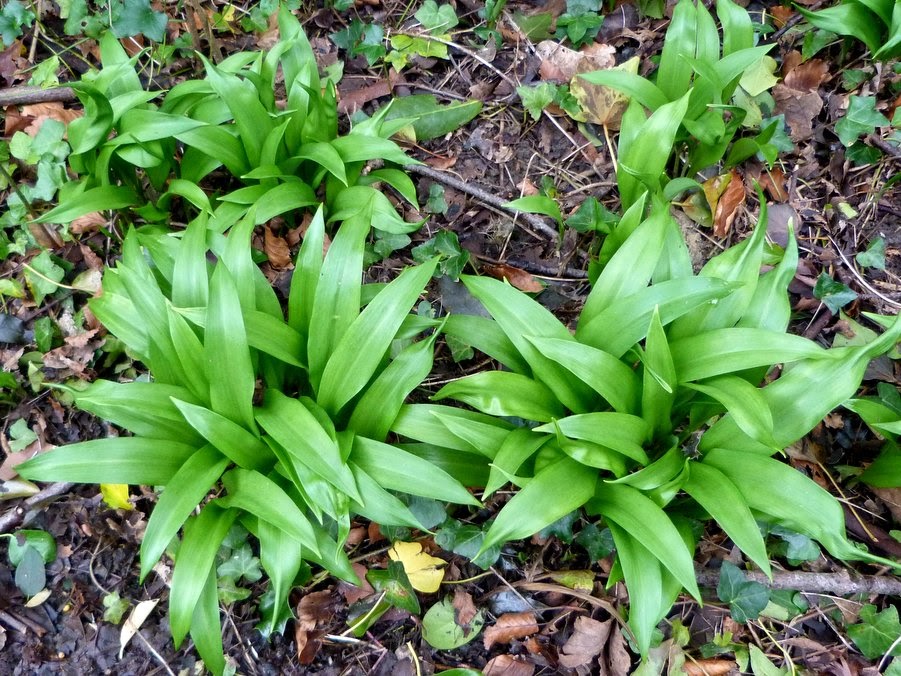
We did the usual shopping and then our short top of the glen walk.  There are no signs of road works starting yet.  I was impressed by the greenness of these wild garlic leaves at the side of the road.  They really are the freshest spring green that one can imagine.

It ended up being a  nothing day in the garden because it didn’t seem worth going out for a few minutes before the forecast rain arrived.  We were warned of rain from mid-morning.  Of course, it didn’t arrive until later than expected - so I should have done some work in the garden.


Saturday was a double nothing day - no walk, no gardening.  It rained hard most of the day.  The only bright part of the day was another victory for the England cricket team in South Africa.


Sunday brought another shopping trip and another walk in the morning before returning home for more TV sport.  This time it is rugby - Ireland is playing Wales in the Six Nations Championship.


Today’s  walk took us down to the river, and back via the Jurby Road, Bowring Road, behind the fire station and along Gladstone Ave. and through the houses to Gardeners Lane - another four mile route.


Near the river there were some bright green patches of Alexanders.  They could challenge the wild garlic in a competition to be the epitome of greenness.


It has been another non-gardening day and another disappointing week as far as progress in the garden is concerned.  But we did increase our walking mileage.  This week we managed a total of close to seventeen miles.

Sunday, 31 January 2016

Winter 6

Diary of an incompetent gardener.

Sunday 31st January, 2016.

If this blog needed a subtitle I think I would choose “Diary of an incompetent gardener”.  My latest resolution is to try to record my efforts to tame the garden every day . . . in the hope that having to write “I did nothing today” for day after day will shame me into getting out and doing some work.

Tuesday was a “nothing” day but I had an excuse in the morning.  The remnants of the storm that dumped all the snow on the east coast of the United States arrived on this side of the Atlantic and passed over the Island.  There was no snow but we did get heavy rain accompanied by severe gales.  There wasn’t any significant flooding but the department of infrastructure was kept busy removing fallen trees which were blocking roads.  We put off our usual trip to the shops until Wednesday and I devoted the morning to writing the previous post for the blog . . . until my efforts were interrupted by a power failure.   I achieved nothing after that apart from heating some water for tea on a little gas camping gadget. The rain eased off in the early afternoon and I could have worked outside but I just prowled around waiting for the power to be restored - trying to work out how I could cook supper on one tiny gas ring if the problem wasn’t fixed.  All ended well because the marvellous MEA (Manx Electricity Authority) repairmen got the lights back on at about half past three and I managed to finish the Winter 5 post before supper.

Wednesday started with more heavy rain and strong winds and we decided to put off the shopping until the late morning when the wind was due to drop and the rain become showery.

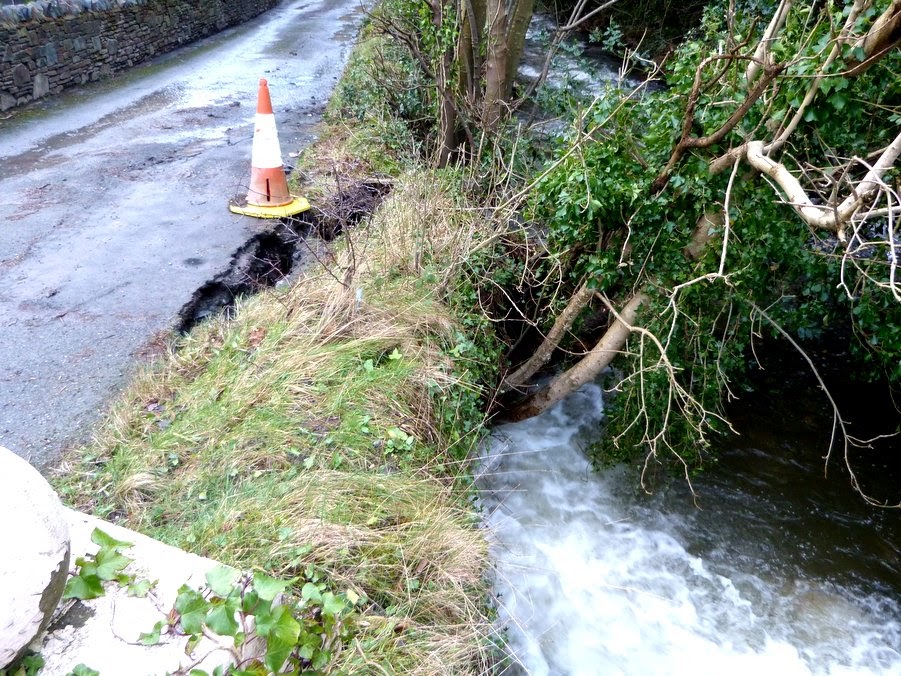
After lunch we did the short “top of the glen road walk”.  First up to the turning circle at the top of the Fern Glen road and then up the main glen road to the gate at the end of the tarred road.  We didn’t see any evidence of tree damage to overhead power lines on our walk, or when we drove down the glen on the way to Ramsey so the cause of yesterday’s power failure is a mystery.  We were passed by an Infrastructure van on our way up the glen and assumed that the driver had been up to check on the damage to the river bank.  When we reached the bridge across the river to Wildwood House we discovered the probable reason for his visit.  There was a traffic cone near some new damage to the river bank. Just below the bridge the river is partly blocked by an old metal structure which serves no apparent purpose - possibly the remains of an old bridge.  


It has diverted the main torrent of water towards the river bank and the flood water has undermined a fairly large, ivy covered, tree which has fallen across the river.  The roots have pulled away a section of the bank and a wide crack has opened up at the edge of the road.  Last time we walked up that road the tree was already starting to lean and I predicted this outcome.  I just didn’t think it would happen so soon.


I can’t report much progress in the garden but I did go out for an hour after we got back from our walk and did a bit of tidying up - just picking up twigs that had blown off the trees, and some bits of variegated grass that I dug out last week and left lying on the back lawn.  I started trimming back the Japanese anemones but there was a sharp shower and that was the end of the gardening.

Thursday was another “nothing” day as far as gardening was concerned.  We did our Whitebridge walk after morning tea.  The morning had been overcast but dry.  It didn’t stay dry for long.  We had only been walking for a couple of minutes when I stopped by St Fingan’s chapel just across the bridge over the Auldyn.  I wanted to photograph the first daffodil flower that I have seen in the glen this year.


While I was taking the photo I felt the first couple of raindrops.  They were heavy enough to make ripples in the puddles on the road but there wasn’t enough rain to saturate us and we persevered with the walk.  

It wasn’t very eventful but we did solve the mystery of the missing ducks which used to congregate by the ford near the footbridge.  While we were walking past Greenlands, a big house close to the river, with a wooded garden and a large pond, we saw someone scattering bird food in the grounds.  There were hordes of ducks and even a solitary moorhen gathering for a meal.  A few minutes later we met a lady on the bridge who was feeding the gulls.  She said that she had hardly seen any ducks near the bridge for months and the few that she had seen all disappeared in the direction of Greenlands.  So they have probably deserted the river and moved their headquarters to the Greenlands pond. Not a bad move considering the strong currents in the river - and the free meals at Greenlands.

After we got home the rain became more serious and all thoughts of gardening were put on hold.

I haven’t written much about our garden birds recently because we have just been getting the usual visitors on the feeder, but today Tim counted 9 siskins, mainly on the niger feeder.  This is the first year that we have had resident siskins all through winter.  It could be due to the milder weather, or maybe the reason is that the supply of niger seed has tempted them to stay.  But we only had two or three visiting the garden most days since most of them left at the end of autumn.

I also haven’t mentioned another resident in the garden up until now because most people don’t approve of the larger rodents known locally as longtails. The unfortunate creatures are almost universally despised.  We have one living in the garden and she is usually referred to as “our friend in the back” because she has excavated a home under a piece of plywood below the bird feeder behind the house.  I thought of removing the plywood in case  her presence attracted cats from neighbouring gardens.  But it seemed too mean.  She must be so delighted with her lovely dry home with its sturdy roof . . . and the added benefit of scraps of peanut and sunflower seeds falling to the ground outside her front door like manna from heaven.  I decided to let her be as there is no danger of an infestation of longtails.  We have a surfeit of furry predators patrolling the garden.  There was an amusing incident the other day.  A female blackbird was picking up food outside the entrance to our friend’s  burrow.  She poked her beak down the hole to peck at a morsel just as the occupant emerged.  I don’t know which one got the bigger fright.  Later we saw our friend altering her home.  She filled up the existing hole and excavated a new entrance about six inches closer to the feeder pole.  I am not sure why she thought that a relocated entrance would deter intruders.

Cats are not the only predators hunting our smaller furred and feathered residents.  We have had considerably fewer chaffinches recently. In the summer they were our most numerous garden birds but recently I have only seen three or four.   I think the decline may be due to a sparrowhawk which seems to visit us most days.  There was an article about a winter garden bird count in the Guardian this morning in which they were predicting a lower count than usual because of the exceptionally warm weather.  A couple of readers’ comments under the article indicate that other bird watchers are also concerned about sparrowhawks. Here are a couple of extracts:

“sparrowhawks are decimating the garden bird population here - I even had a sparrowhawk jump onto my arm and sit there for a few seconds, when I cut a hedge back - I'm not sure which of us was more shocked by the experience!”

“ditto round here with sparrow hawks. Never seen them close to the feeders before, but this year they seem to be using them as traps.”  But it is not a good idea to rely on anecdotal evidence.  Another reader commented “Reading University did some extensive research on whether sparrowhawks were lowering bird populations following their recovery to present numbers after crashes during the DDT years...
They found they weren't having an effect.  (Ironically their research has been funded by 'Songbird Survival' a fake conservation group which was set up by part of the shooting industry, which wanted to prove 'raptors' were causing the decline of UK songbirds for its own peculiar ends)”

Friday has been dry - but very windy.  The overnight gales were severe enough to warrant the cancellation of the ferry from Heysham so there were no UK newspapers in the shops this morning.  The gusts were even stronger in Scotland, and in Omagh, Northern Ireland a rabbit became an instant celebrity when his hutch blew over and he had to be rescued from the roof of a bungalow.

After tea I went out to take some more snowdrop photos.


While I was outside I discovered that there were buds on the crocuses under the elder tree . . .


. . .  and was amused by this bird-sown cotoneaster by the stream. It can't decide whether it is summer or autumn. 


We didn’t walk until after lunch because Tim wanted to watch the end of the  tennis on TV.  We just did a repeat of our “top of the glen road walk”.  Then I couldn’t face up to recording another non-gardening day so I worked outside for about an hour until the light started to fade.  It was a second tedious session of variegated grass removal. I am about two-thirds of the way through the task now. Another hour and I should be almost finished.  It isn’t easy because this variety of grass has long, tangled roots.  I can’t get every bit of root out and the remaining pieces will probably all send up shoots - so I will have to dig it out all over again in spring.

Saturday promises (or threatens) to be a cold day with wintry showers and possibly snow on the hills.  I need to collect some tablets from the pharmacy at Shoprite and we are planning to walk in to Ramsey.

Later
We wrapped up well and set off on the expedition.  Our route took us down to Gardeners Lane and then we turned off into Lezayre Park and continued through the council housing estate on the outskirts of the old town.  The council housing was mainly rebuilt a few years ago and now  looks quite pleasant.  Years ago the area had a reputation for being lawless.  It even had a nickname derived from the name of the ranch in one of those old TV wild west series - the Ponderosa.  The tablets hadn’t arrived at the pharmacy but we had a bracing walk.  On the way back we got a bit confused by the cul-de-sacs and short sections of footpath through the houses in Lezayre Park and end up joining Gardeners Lane from a slightly different direction.  It was worth getting lost because we would otherwise have missed seeing an early sign of approaching spring.  We spotted two magpies busy constructing a huge nest near the top of an ash tree.  While we were watching one bird flew off - probably to collect more building materials - and the other one continued to rearrange the twigs.


On our way up the glen we could see that the Auldyn River was no longer running as strongly after a couple of almost dry days.  A group of happy ducks had taken to the water.  They were ducking and diving and splashing - really enjoying their swim.

Another very short session in the garden.  I picked up the grass that I dug out on Friday and then collected some dead twigs and small branches that had blown off the holly trees . . . and made a start on pruning my”hawthorn table” before giving up because my fingers were numb.

Sunday
A totally “nothing” day - no walk and no gardening.  We did the shopping after the tennis ended and by the time we had finished lunch it started raining.

Summary
I would have liked to achieve a bit more in the garden this week but we have made progress with the walking.  According to the pedometer website we walked a total of eleven and a half miles during the past week.  This is more or less the equivalent of one of our old weekly hikes - spread out over five days.  If we can add a little extra distance each week we should be much fitter in a month or two.

PS As soon as I wrote about the lack of chaffinches in the garden some more turned up. Not as many as last summer but I counted at least eight.

Tuesday, 26 January 2016

Winter 5

Dark days but not for much longer

Tuesday 26th January

Even though the days are starting to lengthen, and we have nearly an hour of extra daylight compared with the beginning of the month, the days are still unusually dark because of all the cloud cover.  If anyone had been crazy enough to try to arrange a cricket match here during the past three months the players would have spent the entire time in the pavillion - either waiting for the rain to stop, or after successfully appealing against the light.  I can’t remember the last time we were able to read a book during the day without having to turn on the lights.  

By the way, I am puzzled by why we have twice as much extra daylight at the end of the day as we have at the beginning.  Perhaps it is something to do with angles.

Very little is getting done in the garden.  Collecting wet leaves for the leafmould bin and cutting back dead and semi-dead wet vegetation are not not my favourite garden tasks and there is little else to do at this time of year.  Last week I started digging out a patch of unwanted variegated grass so that I could plant something more interesting but that wasn’t much fun either and I came in without finishing. I lost motivation when my feet became numb from the cold.  wellies are not the best footware for keeping feet warm but they are essential because the garden is so wet.

We have been going on short walks almost daily.  We started off walking in the plantations, mainly Skyhill, but the paths were so muddy and slippery that we could only walk slowly and carefully and even then my feet slipped once and I managed to topple over.
The walks have been rather repetitious but I have taken a few photos.  On the 12th we walked up the glen road as far as the waterfall just beyond the ruined shepherd’s house.


We had hoped that the track would be safer underfoot than the plantation paths but it wasn’t much better - stony and muddy with puddles and even running water in places.


We passed the place where I photographed the wind-damaged conifer leaning across the road at the end of last month.  All the leafy branches had been removed and the only signs of the fallen tree were a pile of thick branches which had been saved for firewood . . . and a gap in the row of trees.  Luckily there was no domino effect and the remaining trees are still standing.  I wonder whether they were originally planted as a hedge and then neglected for many years.  There are more than twenty trees growing along the road boundary of two fields.  I took this photo to give an impression of how tall they are.


The history of the Glen is a source of fascination but also frustration because so little information is available.  For instance, just beyond the leylandii “hedge” we can still see the remains of a mill race at the side of the road.  There isn’t much left - just a leaf-filled depression above an earth bank.  (Another short section of the mill race is still visible further downstream near Race Cottage.)


Years ago the glen used to be very different.  It is nearly all residential property now but in the past there were farms, tourist attractions, at least three mills on the Auldyn River, exploratory mines, a slate quarry and other industry.  The large stone house below that section of the mill race is called The Old Mill.  I believe that the present building was erected near an even older building of which no trace remains.  It may have been demolished when the road was rerouted after the 1930 flood.  I tried to find out what type of mill it was but the only reference I could find to an industry on the site was this comment on the Manx Electric Railway Society’s website “A number of plants and mills in the Island processed inorganic chemicals for local use, including the now ruinous Glen Auldyn chemical works at SC432931”  Perhaps the older building was used to process chemicals.

There was a brief cold snap with a frosty morning on the 16th.  It wasn’t a very hard frost but enough to turn the foxglove leaves white.


We risked the mud which was even worse if that was possible and walked in Skyhill plantation again.  There was no snow at lower levels but top of Snaefell was white.


Moss loves the damp conditions and was was flourishing on the bark of this ash near one of the streams which cross the plantation path.


On the 19th we gave up on the mud, changed tactics, and took to the roads.  We walked down the glen, crossed Lezayre Road and continued down as far as the footbridge over the Sulby  This is a more or less level route and not such good exercise as climbing the fairly steep paths through the plantations.  But we were able to walk much faster and almost twice as far which compensated a bit.  According to a very useful website http://www.gmap-pedometer.com/ the distance from our gate to the footbridge is exactly 1.4396 miles - so it is close to a three mile walk there and back.

I took some bread cubes for the ducks that usually congregate near the bridge - hoping for handouts from children visiting the little Poolydooey nature reserve on the bank to the river.  There were no ducks in sight.  The state of the muddy and debris-strewn track down to the ford where the duck-feeding usually occurs was enough to deter even the most determined child.


We crossed the bridge and were greeted by a group of gulls that appeared from nowhere.  Gulls appear to be psychic where bread is concerned.  Feeding gulls is frowned upon but at least I didn’t have to carry the packet of bread home again.

On the way back we were greeted by a friendly pigeon that flew over and perched on a garden wall.  It cooed to us, hopped along the top of the wall, doing a little pigeon dance and listened to every word when I stopped to talk to it.


We walked down to the Sulby again the next day.  On the way home we heard cooing again as we passed the house where we had seen our friend the previous day.  I looked into the garden and saw him perched on top of a campervan.  Then he flew onto the roof before fluttering over to the gatepost.  While I was taking his photo, he took off again and landed on my head.  I couldn’t take a photo because the camera strap was round my neck.  He showed no sign of moving.  I had to ask Tim to remove him and then he hopped onto Tim’s arm.


While all this was going on a rather dour postman arrived to deliver the post and totally ignored the antics of the couple of eccentric walkers and their feathered friend.  We haven’t seen him since - the pigeon, not the postman.  But, on a later walk, we did hear more than one pigeon cooing near the old Ramsey power station on Gardener’s Lane which is about half a mile downstream so we hope he has been reunited with some pigeon friends.

We didn’t walk on the 21st because it rained all day, culminating with a heavy downpour during the early hours of Friday morning - another three inches in not much more than a day.  The rain cleared early though and we were treated to a very pretty sunrise.


After shopping we . . . (at this point work on the blog was rudely interrupted by a four hour power failure on Tuesday morning - probably caused by damage to power lines due to the gales) . . . walked down to the Sulby again and I recorded some post-downpour images.

First, our little waterfall in the back garden.


Then a view of the river from the bridge near the chapel.  The level had dropped since early morning but there was still plenty of white water.


As we approached the Lezayre Road junction we could see that the river had overflowed again and water had been running down the road.  Debris was trapped under the wooden fence where the water had spilled over into the Milntown gardens.  This is the second time this winter that the road has flooded.  Luckily it never lasts long because the level drops very quickly as soon as the rain eases off.


I think the main reason for the flooding of the road is that the Lezayre Road bridge isn’t high enough to cope with the run-off after an extreme downpour and the water backs up above the bridge.


We crossed the road and walked down Gardener’s Lane.  There used to be open fields here, between the river and the disused railway line, where we walked the dogs - but now a new housing estate is taking over.  Beyond the new houses there are still a few remaining overgrown fields and a pair of impressive trees, oaks I think but I will have to wait for the new leaves before I am certain.


The river was higher than previously and there was a little island on the debris by the ford which was being patrolled by a hooded crow.


If one takes time to stop and stare there is beauty in the most unpromising places - like puddles on a road.


On our way home I stopped to watch a pair of mallard ducks.  They  were battling to paddle up the fast flowing Auldyn river and keeping to the quieter water next to the bank.  You would think that all this rain would be lovely weather for ducks - but there can be too much of a good thing.  The female mallard suddenly got caught by the current and was washed out into the middle of the river and swirled downstream in the torrent.  She was followed immediately by her anxious mate.  Further up some more sensible ducks were lined up on the grassy bank between the Rose Villa parking area and the river . . . waiting for better days and calmer waters.


On Saturday we walked up the glen to see how the repairs to the road had fared.  The main repair to the river bank which I photographed for the Winter 4 post was fine but the second repair up near Fernside had sustained further damage.  Most of the small chunks of granite which had been packed behind the wire mesh had been washed out and there was a rather ominous crack at the side of the road.  


But there is some good news.  Snowdrops are opening all over the garden and things can get better in the garden as the days get brighter and we approach spring.