Thursday, 19 May 2016

12th to 15th May

More walks and some gardening.

Thursday 12th May to Sunday 15th May

After morning tea on Thursday we drove down to Ballaglass Glen to see the bluebells.  We took the scenic route through Maughold Village and Ballajora.  It was another warm, sunny day but the air was rather hazy, not ideal for distant views.

While I was waiting for Tim to put on his boots, I managed to photograph two butterflies near the car park.  They were both whites and both males.  The light was too glary to get really good photos of white subjects in the sun but the photos are good enough for identification.

A green veined white.

An orange tip.

We saw quite a few other whites on the walk but they were all too far away and too active to identify.  The only other butterfly that we saw close-up was a speckled wood.

We decided to walk through the glen to the bottom gate near the Mill House, take the rough  track through the Barony down to Cornaa, and then return by the same route with a detour around the best bluebell patches in the glen on the way back to the car.   

It was yet another case of best laid schemes ganging agley.  When we reached the short section of footpath through the Mill House garden, and the smaller branch of the river, we discovered that  the bridge was no longer there.  It must have been a victim of the winter floods. The river is shallow but we didn’t want to risk wet boots at the beginning of the walk so we walked back upstream and did our bluebell tour before setting off down the road.  Dorothy hadn’t exaggerated.  The flowers were absolutely lovely.


As we walked down the road past the Mill House, I stopped to take some photos of the missing bridge and we realised that something even more important than the bridge was missing from the scene. The huge rhododendron tree, said to be the largest in the British Isles, was no longer standing in the front garden.   I cannot believe that it would have been deliberately removed so I assume it was also a victim of the winter gales and raging flood waters.


11th April 2012 - my last photo of the famous old tree.


On our way down to Cornaa we came across some workmen using a small earth-moving machine to repair the surface of the track.  They stopped to let us pass.  We decided to change our plans and walk back via the road over the Cashtal yn Ard hill so that we wouldn’t hold up their work a second time.

There was no escaping bluebells during the walk, there were patches all the way along our route.  These were growing amongst the ferns behind an old moss covered stone wall not far from the ruins of the  belllite factory.


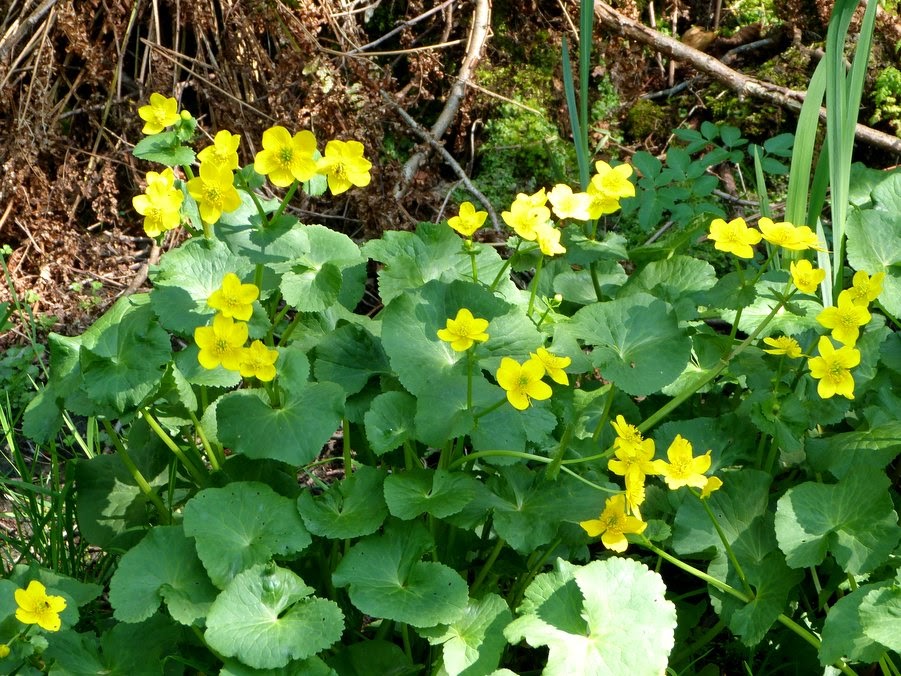
Down at Cornaa we saw the last of the marsh marigolds.

And as we started up the hill on the last leg of our triangular walk, we found a big patch of pink purslane growing on a steep bank above the road.  This is a magnified image of the tiny flowers.


As we approached the top of the hill these stunted oaks were a warning of how hard life is up in the windswept hills for even the toughest of trees.


The gorse seems to cope with the wind though, and patches of bluebells and white stitchwort thrive on the sheltered side of the bank.


We thought we deserved a rest on Friday after the longer than usual walk the day before and I took advantage of the break in exercising to mow the grass.  The only interesting event was the sighting of the first butterfly in the garden.  Yet another unidentified white.

Saturday was the day of the big mountain bike race in our plantation.  It started at Milntown at 10 a.m.  I decided to take some photos and found a good place at the top of a bank just inside the gate into the plantation.  While I was waiting I took some photos of the bluebells on the slope above the track.  They are improving every year and should soon rival their celebrity cousins in Ballaglass.


There were more entries to the race than I expected and it took about two and a half minutes for all the bikers to pass me.


When I walked back down the road I was shocked to see how quickly parts of our beech hedge had shot out.  Some of the new shoots were nearly a foot long.  I usually give the hedge a spring haircut during TT race week when the roads are closed  but that is not until June so I will have to start earlier this year. When I got home I  took this photo of my favourite shrub in the garden - the azalea mollis.


In the afternoon we went for a walk in Skyhill Plantation (as far as the top of the Ballagarrow paddocks) - safe in the knowledge that all danger of speeding bikes had passed.  I wanted to see the bluebells in the field near the farm boundary but they were disappointing this year.  The grass had grown too long, possibly because of the warm, wet winter.


On Sunday we had to sandwich a short walk in between the motor racing and the tennis on TV so we chose the top of the glen road walk.  Before we left I spent about an hour making a start on the beech hedge and then tackled the long shoots on the clematis that were threatening to block the front steps.

There wasn’t much to see on the walk but I rather liked the sun shining through the new red leaves of this acer in Fern Glen.   It made a change from all the greenery.


Later, while I was pulling out a few weeds near the gate I noticed a little wild garlic flower under the Lawson’s cypress.


I had been thinking about planting a few bulbs near our stream but was dithering because it can be quite invasive.  Then I remembered seeing some leaves that looked suspiciously like garlic under the forsythia by the crab apple last year - and went to check.  Sure enough there were a few flowers there too.  If I remember I may dig them out and plant them in a better place near the stream.  I didn’t know that birds ate the garlic seed but some of them must.  There is no other way it could have travelled into the garden.

While I was searching for garlic, I noticed that there was blossom on the crab apple . . .


. . . and the  Solomon’s seal had suddenly shot up and had buds.  It often gets attacked by slugs and sawfly larvae so I took a quick photo while it was still looking good.


Before I went inside I saw that the first oriental poppy had opened down by the turning circle.  We waited for so long for spring and weren't expecting to see the first sign of summer so soon.


Monday, 16 May 2016

6 May to 11 May

Five warm spring walks

Friday 6 May to Wednesday 11 May 2016

After a cold start to spring there was a sudden change in the temperature on Friday 6th May.  Instead of the usual maximums of 10 to 12 degrees C - the temperature “soared” to a predicted max of 17 degrees on Friday, then gradually increased until it reached 21 degrees on Monday - a record high for the 9th of May on the Island.  This was followed by three more hot days before it started to return to more normal temperatures for this time of year.  The unusually hot sunny spell of weather caused a surge in spring growth - blossom opened almost overnight, leaf buds unfurled on the deciduous trees and the glen resonated with the sound of lawnmowers trying to tame the rampant grass.  It was wonderful weather for walking.

Friday  It should have been just a regular Whitebridge and Poyll Dooey walk . . . but it wasn’t.  It was special because we heard the distinctive call of a cuckoo as we passed Milntown.  It was the first time I had definitely heard a cuckoo on the Island.  Years ago, I thought I heard one further up the glen but I wasn’t positive.  But this time Tim heard it too - and we checked the call on the Internet.  It was definitely a cuckoo . . .  unless someone was playing a recording of a cuckoo very loudly in the Milntown grounds.

There wasn’t much to photograph at Poyll Dooey apart from new leaves and the last of the dazzling white froth of blackthorn flowers near the entrance to the park.


Saturday  A rainy day.  A friend sent me a photograph taken through her bedroom window so I sent this in return . . . our wet patio and the first blossom starting to open on the flowering cherries.


Sunday was brighter and we walked down to Poyll Dooey again.  We listened for the cuckoo but it had departed, probably in search of a mate further afield.  The only sound of spring was the roar of motorbikes speeding along  Lezayre Road.

I continued my examination of the new leaves on the trees in the park  - trying to identify them.  A row of trees that we had not noticed previously had interesting coppery leaves which looked poplar-shaped.  When we got home I found some very similar photos on the internet and decided that they must be black poplars (populus nigra) - a native tree that grows well near water.  According to the Woodland Trust black poplar is the most endangered native timber tree in Britain


When we got home I photographed the first pink clematis flower and the last of the daffodils.  The cherry blossom was opening fast and we decided that our next walk should be up to the service reservoir again to see whether we could get a good view down on the cherry trees in the glen.

Monday was a lovely warm spring day - perfect for our first “sunhat walk” of the year.  The view of the cherry trees from the top fields was disappointing as most of them were hidden behind houses, or larger trees.  I took a photo of more or less the same scene of our part of the glen as photo in last week’s post.  It is interesting to compare the two, to see how much has changed in just six days.
3rd May

9th May

We walked past a small plantation of conifers to check the view from the hillside above Fern Glen.  This is closer to the position from which the old photo in last week’s post was taken.  I think the photographer must have set up his camera where the conifers (behind the gorse on the left hand side of the next photo) have been planted.


On our way down the rough track Tim saw our first butterfly of the year in the glen. . . . a speckled wood.  


We haven’t seen any butterflies  in the garden yet although our neighbour saw an unidentified white butterfly fluttering past her kitchen door a few days ago.

After being frustrated in my efforts to photograph the cherries from the opposite side of the glen, I decided to take some photos in the garden.  The blossom is really good this year because we have been enjoying still dry weather - ideal for the delicate flowers.


Tuesday and another walk down to the Whitebridge and Poyll Dooey.  While I was waiting for Tim, I took a photo of some clematis flowers by the front steps.


When we reached the Sulby, the tide was high and just about to turn.  


We couldn’t work out whether it was just before or just after peak tide because some gorse flowers, floating on the surface, seemed to be heading slowly downstream while others were going in the opposite direction - possibly being blown by the gentle breeze.  Then I saw a mallard family near the reeds by the Whitebridge.  


They were too far away to get a good photograph so I took off at top speed to get a closer view but my efforts were thwarted when a shrill party of schoolchildren approached the bridge from the far side of the river and the ducks beat a hasty retreat downstream.  We retraced our steps and I got some more photos.  They weren’t as sharp as I hoped.  I had no idea that baby ducks could swim so fast.


On the way home we caught up with the “duck scarers” - resplendent in their high-vis waistcoats.


On Wednesday we did our top of the glen road walk.  I took my camera although I didn’t expect to see anything interesting.  Cuckoo flowers got their common name because they are supposed to flower when the cuckoos are calling.  The ones in our garden haven’t opened yet but there was a good patch at the side of the river up in Fern Glen which have nearly finished flowering.  It is a confusing spring.


When we crossed  the bridge over the Auldyn River on our way home,  I noticed a male mallard in the water.  While I was watching him I realised that he was watching a female and that she was being followed by some tiny balls of fluff.  She stopped to have a drink.


The little party made their way up towards the bridge.  The river wasn’t running very fast but the babies  had to battle against the current and preferred to climb over the stones whenever possible.


When they reached the calmer water below the weir they swam after their mother.  I couldn’t get more than seven babies in the photo but there were nine.


In the afternoon I received an email from Dorothy with three glorious photos of bluebells in Ballaglass and the comment that “. . .  Trevor says they are best he has ever seen.”  We decided that we had to see them for ourselves and planned to visit Ballaglass the next day.  My bluebell photos will be in the next post.

Saturday, 7 May 2016

Back again

Back again


Saturday 7th May, 2016


That break from posting lasted longer than I intended. Nothing was written because there was nothing to write about. We were going on very repetitious walks and there was very little happening in the garden.  Spring really dragged its feet this year.  


I also felt  that what the world needed was less words not more.  The combination of various elections and the looming referendum on the mainland has been swamping the media and social media websites with more insults, lies and unpleasantness than usual.  The only interesting thing is noticing how the selective reporting of the “news” on TV and radio amounts to subtle propaganda.  But I don’t feel too guilty about adding to the glut of words again because this is a diary and I am really just talking to myself.


I was tempted to start writing and posting photos again after a memorable walk in the woods last Saturday.  We were just going to walk up through Skyhill plantation - a walk we have done so often before that it seemed pointless to take a camera.  This was a mistake because we extended the walk and it turned out to be the type of day that should have been recorded for posterity in “glorious technicolor”.  We repeated the walk on Monday so that I could take some photos.


We walked along the mountain bike path at the top of the plantation.  It can be very muddy and we had avoided this route since  the floods last autumn.  We were surprised to find that the path had been hugely improved since our last visit.


Little drainage ditches had been scraped to drain the muddy dips where water collected.


A short “boardwalk” (sadly not quite long enough) had been constructed over one of the worst boggy bits, the source of one of the little streams that runs down the side of the glen.


Some trees had been felled to widen the track, and last winter’s  fallen trees had been cut up and dragged off the path.


And approaching the point where the path turns through a gap in the old stone wall, the path had been diverted to avoid a group of large conifers which had come down in the gales.


Above the Ballagarrow paddocks we stopped to admire the view of Ramsey.  The sun was shining again but the view wasn’t quite as spectacular on our second visit because the visibility had deteriorated and we could no longer see the snow-covered peaks of the distant Cumbrian hills.


We continued along the path to see whether the access across the stream between the south and north sides of the plantation had been improved.  We were not disappointed.  This is where we used to cross the stream after sliding down a steep bank . . .


. . . and this is the new crossing further up the hill.


When we returned along the path we met two hikers who were resting above the Ramsey view site.  They mentioned seeing this part of the plantation from the far side of the glen when they walked up to the service reservoir.  I said that we hadn’t visited the reservoir because we thought it was on private land and the one hiker replied “They don’t mind people walking up there.”  We weren’t quite sure whether the “they”, who didn’t mind, were the water authorities or the farmers that own the surrounding fields but I had been longing to walk up there so we decided to act on this rather vague second-hand permission.


On Tuesday we set off up the steep access road to the reservoir.  It starts near the old stables which are the only remaining trace of an old farm that is marked as Balleighteragh on some older Isle of Man maps - even the name has disappeared from the new editions.  The track must follow the route of the old farm road up to the fields on the eastern slope of the glen.  Near the top we had a grand view across the glen to the farm across the river, Ballagarrow.  It is now a private home with a B & B in the adjoining cottage and the old farm fields are used as paddocks for horses.  The air was heavy with the heady scent of gorse.


We were mainly interested in seeing views of the glen from a different angle.  We knew that the reservoir is underground and wouldn’t be very interesting because we can see it from the west side of the glen.  But I thought I should record the visit.


The gate into a nearby field was open so we walked across to get a better view of the little group of houses where we live and their setting below the long ridge of Skyhill.  


I had hoped to be able to photograph the glen from the same position as the photographer who took the old photos which I mentioned in an earlier blog on 24th July 2014. http://2caillagh.blogspot.com/2014_07_01_archive.html  It wasn’t possible because the trees have grown up so much in the past hundred years.  This is the best that I could do. I don’t know the date of the earlier photo but it must be pre-1930 because it shows the glen before the flood.  The only houses that can be seen in both photos are Sunnyside Cottage on the left edge of the old photo and Rivers Lea, the large three-storey house by the river - only the gable end of Rivers Lea is visible in my photo.  I may be able to get a better photo next winter before the new leaves on the trees start to block out the view.


On Thursday we walked in Skyhill Plantation again and I was inspired to visit another site which I had been wanting to see for years - the keeill on Skyhill Farm.  I had been putting off for ages because I am nervous about trespassing and I didn’t know who owned the land so I couldn’t ask for permission to visit the site.  I knew the keeill was only half a field from the edge of the plantation so I decided to sneak over the boundary fence instead of approaching from the Millennium Way which would entail a long uphill walk..


I had wondered about the remote position of the keeill.  Apart from Lag ny Keeilley (or Killey) most of the keeills are not so remote and I can’t think of any others which are on the top of windswept  hills.


The situation is not dissimilar to Cashtal yn Ard and it occurred to me that the Skyhill keeill might have been built on a site of pre-Christian religious significance so I was interested to read this plaque.


The area around the keeill and burial site has been newly fenced and there is a sturdy stile for access so it looked as though visitors are not discouraged.


Apart from this small, child-sized open grave, it was difficult to make out the various features.


The keeill itself is just a faint depression in the ground and I wouldn’t have been able to locate it without the information that it was to the south of the open grave.  


I guessed that these upright stones to the north of the open grave marked later burials.


When I returned home I Googled Skyhill Keeill to find out whether I could unearth any archeological details and discovered that another, far more serious, blogger had also visited the keeill just a couple of days before me.  It was a pity that I hadn’t read her post before I photographed the keeill as it would have given me a better understanding of the layout.  This is a link to the Manxkeeills blog https://manxkeeills.wordpress.com/  The Skyhill keeill post is labelled Keeills and Cake, Magher ny Hoarn Keeill.
Note Magher ny Hoarn is the old Manx name of the field where the keeill is situated.


Later when I was checking the date of the Battle of Skyhill I discovered some other interesting information . . . the reason for all the improvements to the mountain bike trails in the plantation.  On May 14th there will be an important mountain bike race there.  It is part of Isle of Man Cyclefest and this is the lurid description from the Cyclefest website:


BATTLE OF SKY HILL XC MTB

Isle of Man Cyclefest’s cross country mountain bike race will start and finish at Milntown Estate and boasts a leg-breaking ascent of nearby Sky Hill, site of the bloody battle between the Manx and the invading Vikings in 1079.
Competitors wind their way around the hill’s contours before descending through its challenging forest-lined single-track network before another lung-busting ascent over the heather-clad moorland. With hazards and obstacles at every turn, the Battle of Sky Hill will ensure a worthy victor pulls on the first of Cyclefest’s leader’s Yellow Jerseys!


PS  I didn’t realise that we went on such challenging and exciting walks with hazards and obstacles at every turn!


PPS  I must try to compile a catch-up post to cover the gap between this post and the previous one.

Saturday, 5 March 2016

Spring 1

Spring cleaning?

Saturday 5th March, 2016

It is Thursday already and I have only taken my camera out twice so far this week.  Yesterday morning, to photograph the first snow of the winter in our garden . . .


. . . and yesterday afternoon to get a close-up photo of the first daff in the back garden.


Tim’s back is still worrying him.  Since Sunday we have only managed two short  walks - about half a mile up the glen to the end of the tarred road and then back home.  Also the garden is still cold and wet - so there is very little to write about this week.  

**********

Now it is Saturday and there is nothing new to report.  I walked round the back garden with my camera this afternoon but couldn’t find inspiration..  I quite liked a patch of moss flourishing under the young birch - near the stream which runs down the side of the garden in a ditch at the bottom of the old ivy and honeysuckle covered stone wall.  


The birch bark was attractive too - but I couldn’t take a close-up shot of the bark and get the moss in focus.


There was nothing new in the garden, apart from a couple of  well-nibbled primroses.  I suspect woodlice were to blame.  The only other recent flowers were two early dandelions and some lesser celandines.  They are both weeds but I prefer lesser celandines to dandelions which have annoyingly deep and tenacious roots.  Lesser celandines also have the advantage of being early spring flowers and then dying back.  


The last few days of scrounging around desperately for something to photograph  have made up my mind.  This is a good time to have a brief rest from the cold wet outdoors and blogging   I need a new indoor experience.  Perhaps spring cleaning would be advisable.  Like most resolutions it may not last long but if you could see the years of accumulated clutter you would understand why I finish off today’s post with a variation on  Captain Oates famous words  . . .    I am just staying inside and may be some time.